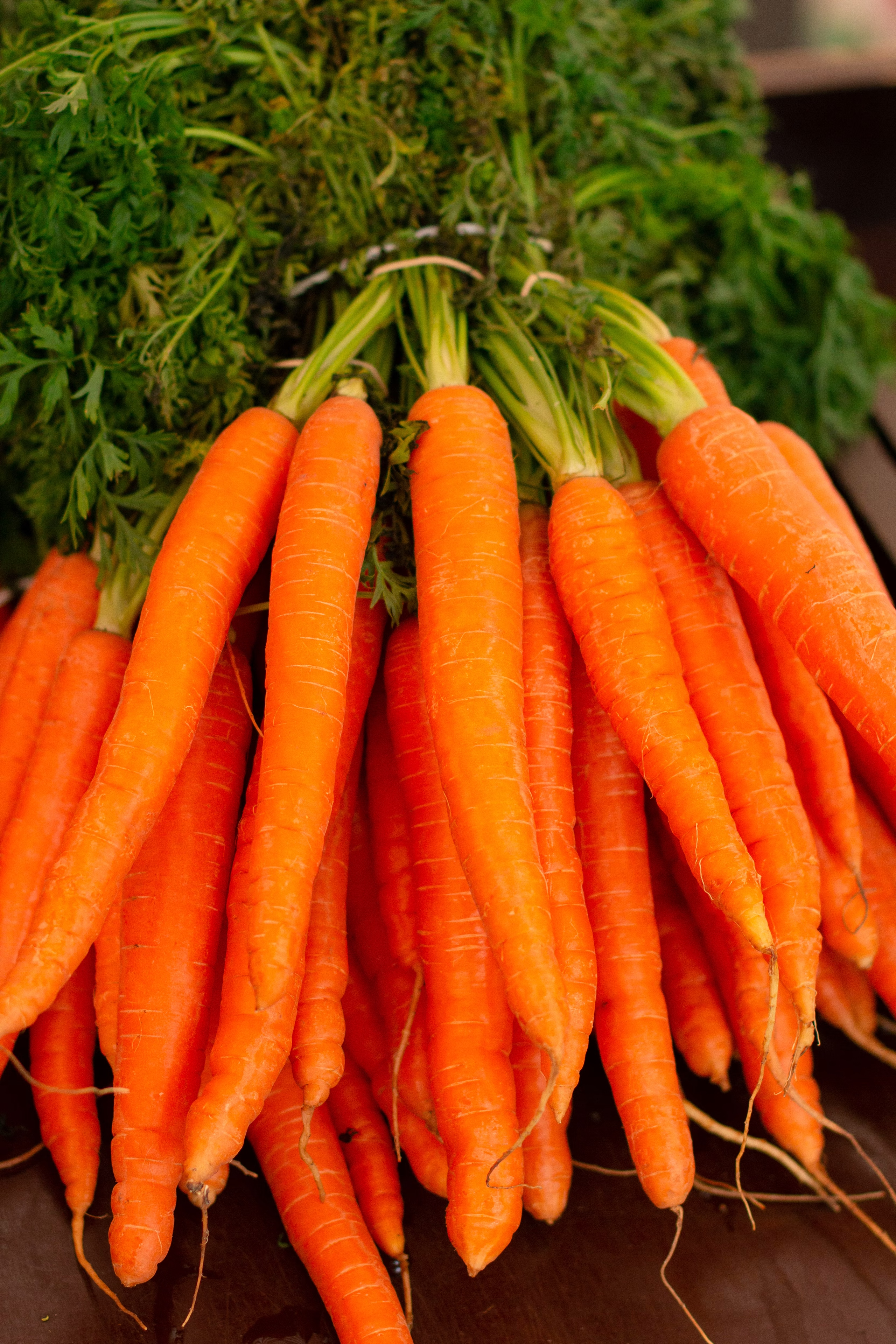
The carrot originates from Afghanistan and Central Asia and was originally cultivated for its aromatic seeds and leaves — not the root. Purple carrots were bred to orange in the Netherlands in the 17th century, possibly as a tribute to William of Orange, and the orange variety dominates the world market to this day.
Popular Carrot Varieties
- Nantes – Cylindrical, uniformly thick and juicy. Classic salad carrot with excellent sweetness. Perfect for pots.
- Chantenay – Short and broad-shouldered. Handles more compact and heavier soils. Excellent for storage.
- Danvers – Cone-shaped, sturdy variety that manages slightly heavier soil. A good all-round carrot.
- Scarlet Nantes – Crunchy, sweet and early. One of the most popular heirloom varieties.
- Rainbow Mix – Blend of red, yellow, white and purple carrots. Spectacularly beautiful in crudités and salads.
Care
Sowing
Carrots are direct-sown outdoors — they do not like transplanting. Sow thinly in rows and then thin to 5–8 cm spacing when the seedlings are about 5 cm tall. Thinned seedlings can be used in salads!
The soil should be at least 10 °C at sowing — from April–May in Sweden.
Light
Carrots do best in full sun but tolerate partial shade. Foliage growth needs light; the root primarily needs warmth and nutrients from the soil.
Soil
Loose, deep and sandy or sandy-loam soil free of stones — stones cause carrots to split and fork. In a container, use a deep pot (at least 30–40 cm deep) with porous potting mix.
Watering
Water deeply and regularly. Uneven watering causes split roots or cracked surfaces. During dry periods — water generously but infrequently rather than a little and often.
Feeding
Avoid fresh manure directly in the planting bed (causes split, hairy roots). Well-rotted compost works best.
Harvest
Carrots are ready to harvest when the shoulders (top of the root) are protruding about 1–2 cm from the soil and have reached the desired thickness. Taste one — home-grown carrots are sweet and crisp far beyond what shop carrots can offer. Autumn-harvested carrots after a light frost are especially sweet.