The Art of Watering Correctly
The question I get more often than any other is: "How often should I water?" And the answer — which frustrates people — is: "It depends." But there's good news. Once you understand why it depends, everything else falls into place.
Why there's no universal schedule
A houseplant's water needs depend on a multitude of factors that vary from home to home and season to season:
- Plant species — a cactus and a peace lily have radically different needs
- Pot size and material — terracotta dries faster than plastic
- Soil type — fast-draining cactus mix dries faster than standard potting soil
- Humidity — dry winter air causes soil to dry more quickly
- Temperature — warm rooms = faster evaporation
- Light — more light = more growth = more water demand
- Season — most plants drink more in summer, less in winter
Understanding these factors is the key to watering correctly — not a fixed schedule.
The finger test — your best friend
The simplest and most reliable way to determine if a plant needs water is the finger test:
Press your finger 2–3 cm into the soil. Still moist? Wait. Dry? Water.
For succulents and cacti you can go even further — let the top 5–7 cm dry out completely.
It sounds obvious, but most watering problems are solved with this simple technique.
The method: deep and infrequent
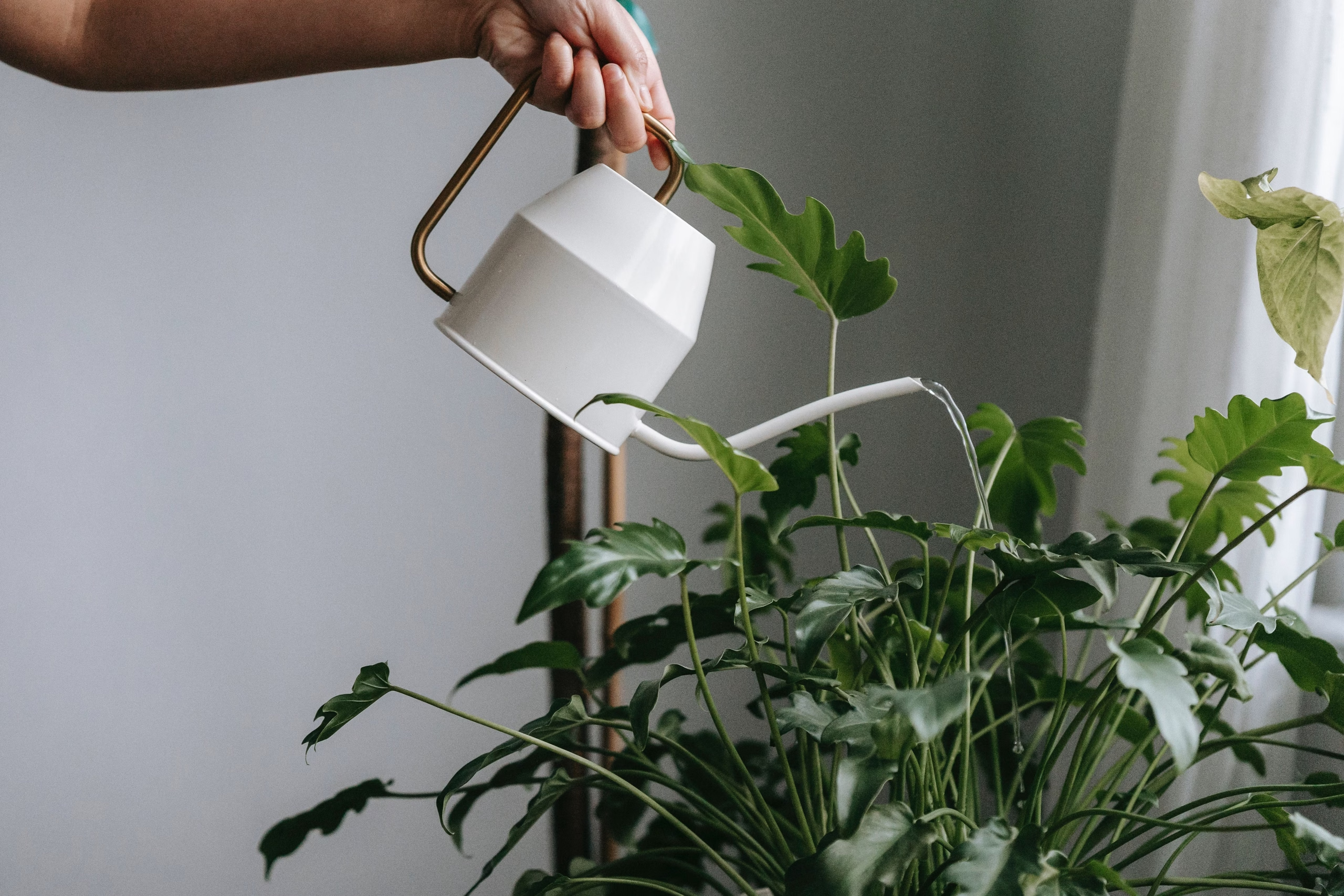
When you do water — water thoroughly. Pour water until it flows out of the drainage hole at the bottom. This ensures the entire soil volume is moistened and that roots deeper in the pot also reach water.
Avoid "sipping" or shallow watering — it leads to shallow root systems that are more vulnerable to drought.
Step by step:
- Pour water slowly and evenly over the entire soil surface
- Wait until water appears in the saucer
- After 30 minutes — empty the saucer so the roots don't stand in water
Common watering mistakes
Too much water is the number one killer of houseplants. Signs: yellowing leaves, mushy stems, mould on soil surface, root rot.
Too little water is easier to fix. Signs: wilting, dry and crispy leaf edges, bone-dry soil, leaves dropping.
Cold water in winter can shock tropical plants. Use room-temperature water or let tap water stand for an hour.
Watering from above onto the leaves can cause fungal problems on sensitive plants like African violets. Water directly onto the soil instead.
Water quality
Most tap water works fine for the majority of houseplants. However, some plants — especially orchids, calathea and carnivorous plants — are sensitive to lime and chlorine.
Options:
- Rainwater — ideal, soft and natural
- Filtered water — removes most chlorine
- Tap water left overnight — chlorine evaporates
Season adjustments
During winter, most plants enter a rest phase. Reduce watering by roughly half. During summer, check plants more frequently and increase watering as needed.
The finger test is your guide year-round — it automatically adjusts to season, temperature and humidity.
A plant that has been slightly too dry recovers. A plant that has been too wet for too long rarely does.
This is the most important principle in plant care — and it starts with the finger test.