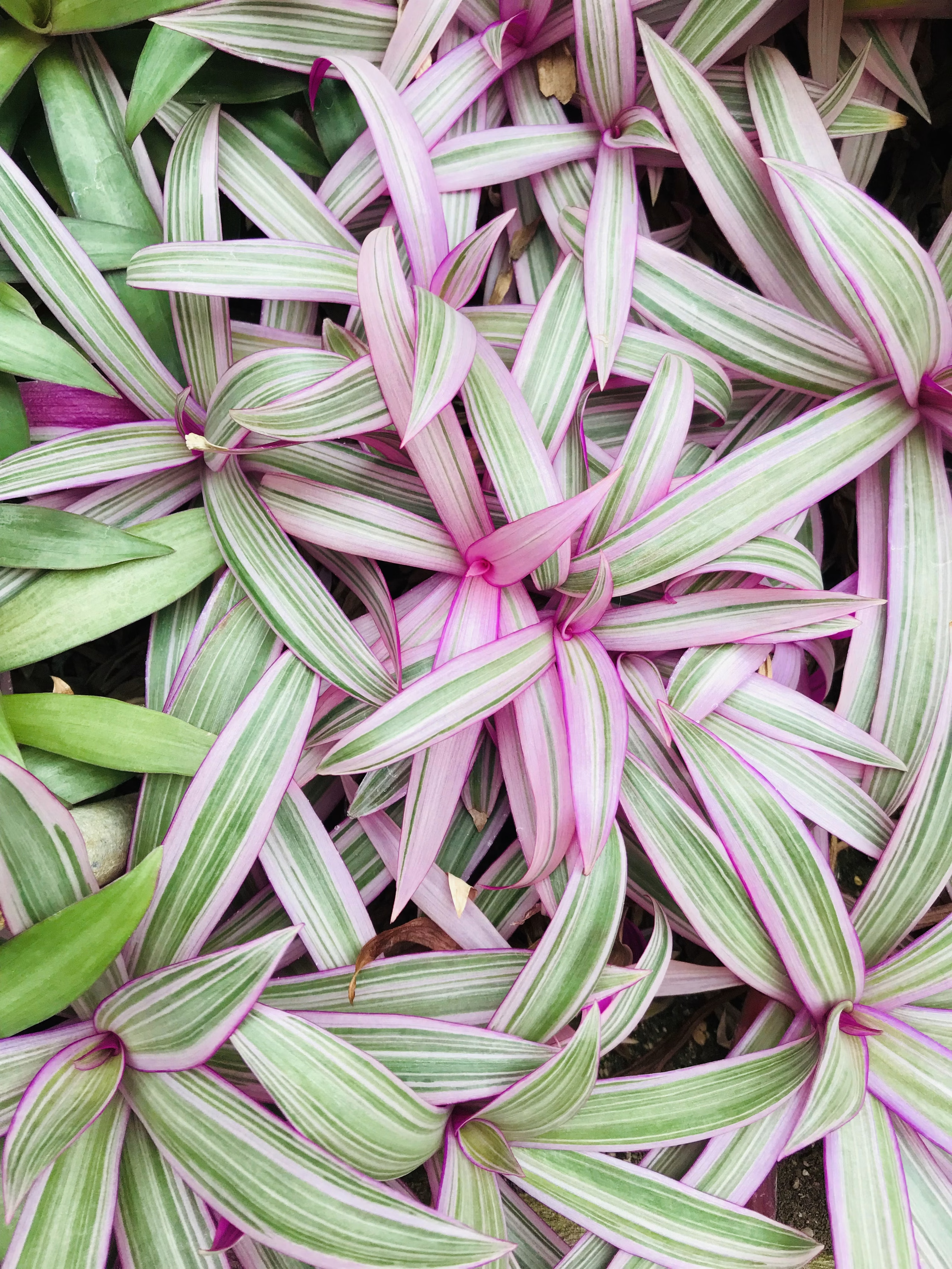
Spiderwort — with its zebra-striped leaves in silver-green and deep purple-red undersides — is one of the most visually dramatic houseplants and yet one of the easiest to grow. It is rare that a plant combines such beauty with such resilience.
Origin
Tradescantia zebrina originates from the humid forests and scrubland of Mexico and Central America. It spreads naturally as a ground cover along forest edges and riverbanks, and it is precisely this sprawling, fast-growing character that makes it a fantastic trailing plant — or a lush addition to a plant arrangement.
Light
Spiderwort needs moderate to bright indirect light to retain its intense purple colour. In too little light, the purple and silver patterning fades and the leaves become uniformly green. In too strong direct sun the leaves scorch. Near an east- or west-facing window is ideal.
The more light it receives, the deeper and more intense the colour — this is one of the most direct relationships between light and aesthetics in the entire plant world.
Watering
Water when the top 3 cm of the soil surface has dried out. Spiderwort tolerates short periods of drying out but clearly does best with regular watering. In summer, water more frequently; in winter, less often. Avoid letting water collect in the leaf axils at the stem — this can cause rot.
Shaping & Pruning
Spiderwort grows quickly and tends to become leggy with long, thin shoots if not pruned regularly. Pinch off long runners just above a leaf node to stimulate branching and denser growth. The removed cuttings can be used to propagate new plants.
Propagation — Extremely Easy
Spiderwort is one of the easiest plants to propagate: cut a cutting with 3–5 leaf nodes, remove the lower leaves, place in a glass of water — roots appear after just 5–10 days. Plant in moist soil when the roots are 2–3 cm long. A few cuttings in a glass of water are a decorative feature in themselves.
Toxicity
Tradescantia zebrina can cause skin irritation from contact with the leaf sap — wash hands after handling. Toxic to dogs and cats if eaten.
Popular Varieties & Relatives
- Tradescantia zebrina — classic form with silver-green patterning and purple underside
- Tradescantia fluminensis — softer, green variant with white-spotted leaves
- Tradescantia pallida 'Purpurea' — uniformly dark purple-red leaves, extreme colour
- Tradescantia sillamontana — white-hairy and silvery, adapted to drier conditions
Common Problems
Fades to green — too little light. Move the plant to a brighter position.
Leggy, thin shoots — insufficient light and/or infrequent pruning. Cut back hard and move to more light.
Wilted leaf tips — dry indoor air or irregular watering. Increase frequency and humidity.
Pests — thrips and spider mites can attack. Treat with an insecticidal soap solution or neem oil.