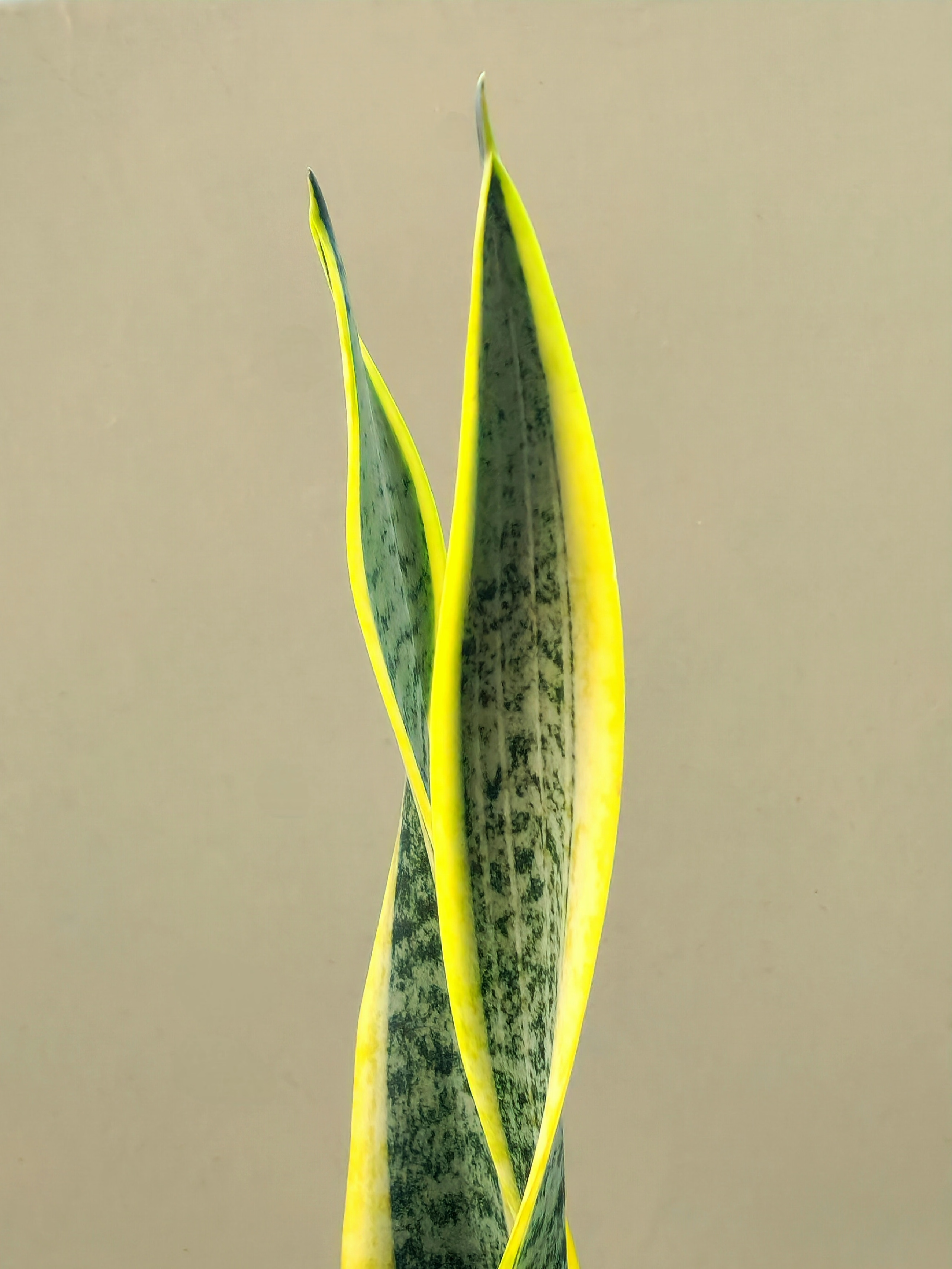
The snake plant — long known as sansevieria — is the perfect houseplant for those who want greenery in the home without investing much time. The upright, strap-shaped leaves with their silver-green patterning and yellow edges are both graphically appealing and remarkably tough.
Origin
Dracaena trifasciata originates from the dry, rocky savannas and rocky terrain of West Africa — from Nigeria to the Congo. In its native habitat it copes with long dry spells thanks to its thick rhizomes (underground storage tubers) that act as water tanks. These are what make the snake plant almost impossible to kill by drought. Despite being officially renamed Dracaena trifasciata after a botanical reclassification in 2017, it is still widely sold and marketed as Sansevieria in the trade.
Light
The snake plant tolerates an unusually wide light spectrum — from near-full shade to direct sun. It is one of the few plants that actually thrives in a dark hallway corner. In stronger light it grows faster, but for the graphic look, low light is perfectly fine.
Watering — Less Is More
The most common reason snake plants die is overwatering. The roots are extremely sensitive to standing moisture and rot easily. Water sparingly: every 3–4 weeks in summer, and every 6–8 weeks in winter. Always let the entire soil ball dry out completely between waterings. Check by inserting a finger 5–6 cm into the soil — if it is still moist, wait another week.
Soil & Pot
Use cactus or succulent soil, or mix standard potting soil 1:1 with perlite or coarse sand. A terracotta pot with drainage holes is ideal — it breathes and keeps the roots dry.
Feeding
Fertilise sparingly — once or twice a year with a balanced liquid fertiliser during the growing season is sufficient. Over-fertilising damages the roots.
Air Purification
NASA's Clean Air Study showed that the snake plant can filter harmful substances including formaldehyde, benzene, trichloroethylene, and xylene from the air. It is also unusual in releasing oxygen at night rather than during the day, making it an excellent choice for the bedroom.
Popular Varieties
- 'Laurentii' — the classic variety with yellow edges along the leaves
- 'Moonshine' — silver-green, almost monochromatic leaves — the most refined variant
- 'Cylindrica' — cylindrical, spear-like leaves — a very modern feel
- 'Hahnii' (bird's nest sansevieria) — low, compact rosette type, perfect for windowsills
Common Problems
Soft, waterlogged leaves — sign of rot. Pull the plant up, cut off rotten roots, and let it dry for a couple of days before repotting in fresh, dry soil.
Brown leaf tips — usually mechanical damage or extremely dry air. Trim cleanly with sharp scissors if it bothers aesthetics.
Leaves lose their patterning — too little light causes the plant to lose its characteristic markings and become uniformly green. Move to a brighter position.