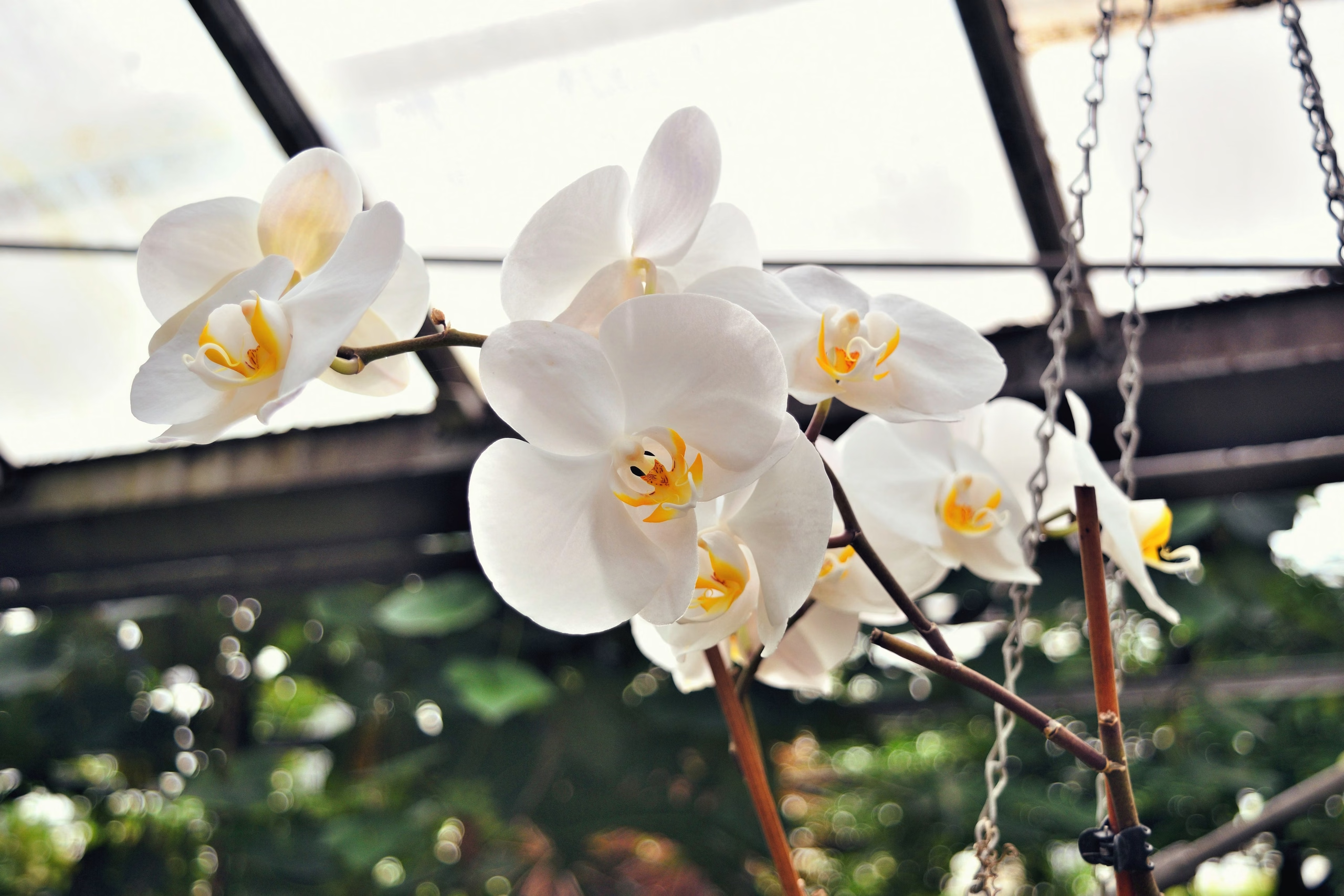
There are plants, and then there are orchids. Phalaenopsis — the moth orchid — belongs to one of nature's most refined creations: flowers shaped like butterflies in white, lilac, pink, yellow, and every shade in between. Getting an orchid to rebloom after its initial flowering is one of the most satisfying moments in indoor growing.
Origin
The orchid family is one of the most species-rich flowering plant families on Earth — with over 28,000 known species spread across almost every continent. The Phalaenopsis genus originates from the rainforest regions of Southeast Asia and northern Australia, where they live as epiphytes — growing on trees rather than in the ground. In nature, phalaenopsis sits attached to branches and tree trunks, with roots hanging freely in the air absorbing moisture and nutrients from rain and dew. This explains their special care requirements.
Light
Orchids love bright, indirect light. An east- or west-facing window is ideal. Direct sun burns the leaves. You know the plant is getting the right light when the leaves are dark green (too little light) versus light green with a slightly reddish edge (just right).
Watering — The Critical Factor
Water approximately once a week during the growing period. The "wet and dry" method is effective: submerge the pot in water for 15 minutes, then let it drain thoroughly. Never let the orchid stand in stagnant water — the roots rot quickly. Keep an eye on the roots visible through the transparent pot — green roots are well-hydrated; white or silvery-grey roots signal thirst.
Humidity & Temperature
Phalaenopsis thrives at 50–70 % humidity. During winter, a humidifier may help. Night cooling (10–15 °C for 2–4 weeks) stimulates flower spike development ahead of the next bloom.
Substrate
Always use a specific orchid substrate — typically consisting of bark chips, perlite, and sphagnum moss — which allows the roots to "breathe." Regular potting soil is not suitable.
Getting the Orchid to Rebloom
When the flowers have fallen, cut the flower spike just above the third node (a small bump) from the base. New flowering is triggered by the nocturnal temperature drop that autumn naturally provides. A successful flowering period can last 2–6 months.
Symbolism
In many cultures, orchids symbolise beauty, strength, and refinement. In ancient Greece they were associated with fertility and masculinity, while in Victorian England they were status symbols among the wealthy. Today, phalaenopsis is one of the most gifted flowers in the world.