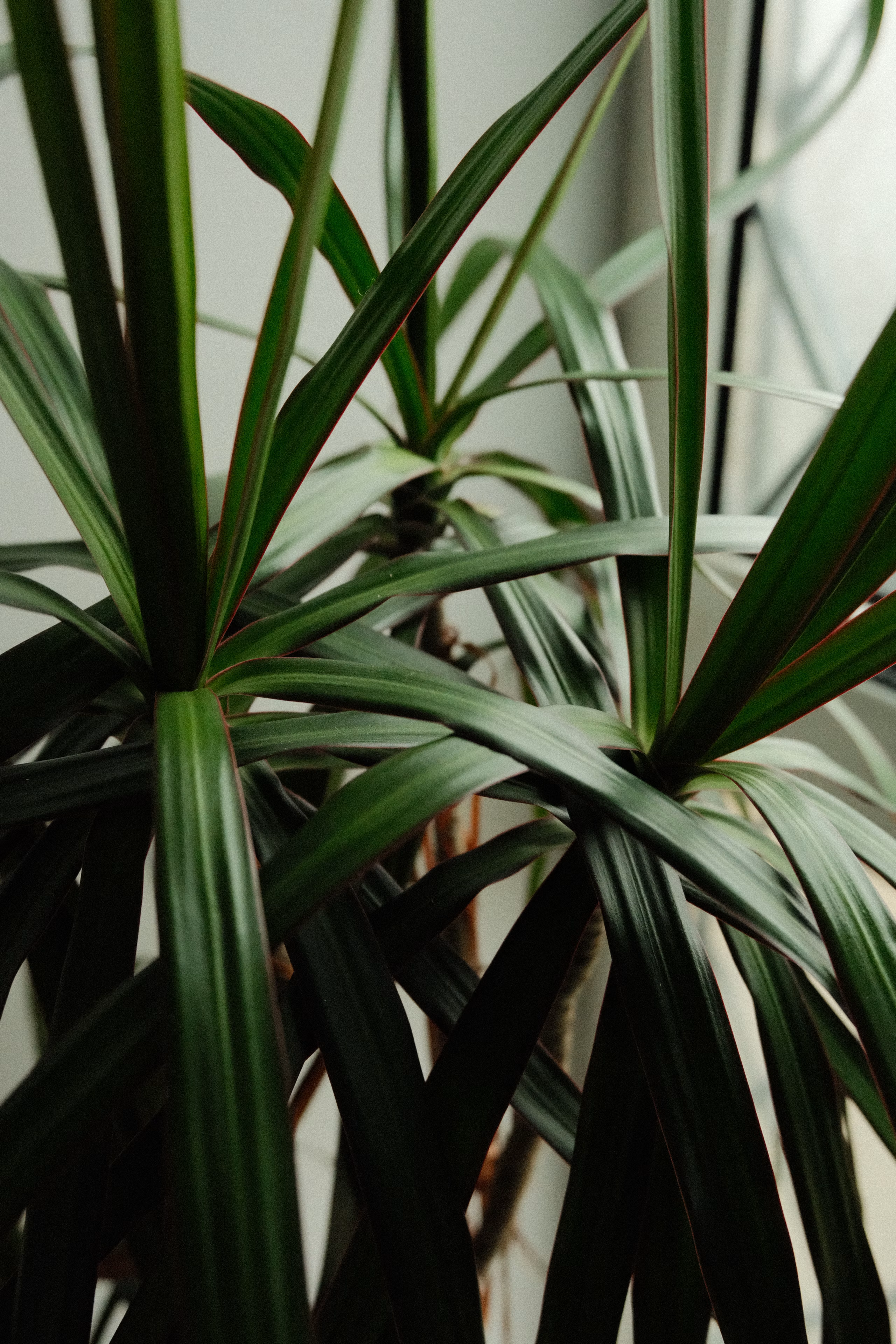
Dracaena marginata — often simply called "dracaena" in garden centres — is one of the most beautiful and structurally striking houseplants. The thin, arching leaves with red or purple edges sit in dense rosettes on slender, cork-like stems that branch over the years to create a unique, almost sculptural silhouette.
Origin
Dracaena marginata originates from Madagascar, where it grows in dry, rocky terrain under intermittent rain seasons. It is a hardened plant adapted to adversity — and this shows clearly in how it handles indoor environments.
Light
Dracaena does best in moderate to bright indirect light. Place it 1–2 metres from a bright window. Varieties with reddish or purple leaves need more light to retain their colours. Dracaena tolerates semi-shade but grows more slowly and may lose its characteristic colouring. Direct sun causes bleached, brown leaf patches.
Watering
Water when the top 3–5 cm of the soil surface has dried out — usually every two to three weeks. Dracaena tolerates some dryness but doesn't like to stay wet. In winter, water more sparingly.
Important: Dracaena is sensitive to fluoride and boron in tap water. Use filtered, distilled, or collected rainwater if possible. Brown leaf tips are the clearest sign of fluoride damage.
Shaping & Height
Dracaena can grow quite tall over the years. To control height or create branching, simply cut the stem at the desired height with a sharp, clean knife. One or two new shoots typically emerge from the cut — a good way to create a bushier plant. The cut tops can be used as cuttings.
Air Purification
NASA's Clean Air Study identified dracaena as one of the more effective air-purifying houseplants — it filters formaldehyde, benzene, xylene, and trichloroethylene. A typical office and home favourite for exactly this reason.
Popular Varieties
- 'Marginata' — standard form with green leaves and red edges
- 'Tricolor' — green leaves with yellow and red stripes, more vivid
- 'Colorama' — intensely red-pink colouring, needs more light
- 'Bicolor' — green-red two-tone variant
Toxicity
Dracaena is toxic to dogs and cats. Symptoms from ingestion include vomiting, salivation, and weakness. Keep out of reach of pets.
Common Problems
- Brown leaf tips — almost always fluoride sensitivity; switch to filtered water
- Yellow or brownish patches — overwatering or direct sun
- Leaves lose colour — too little light; move to a brighter position
- Soft stem — rot caused by overwatering; check roots and act immediately