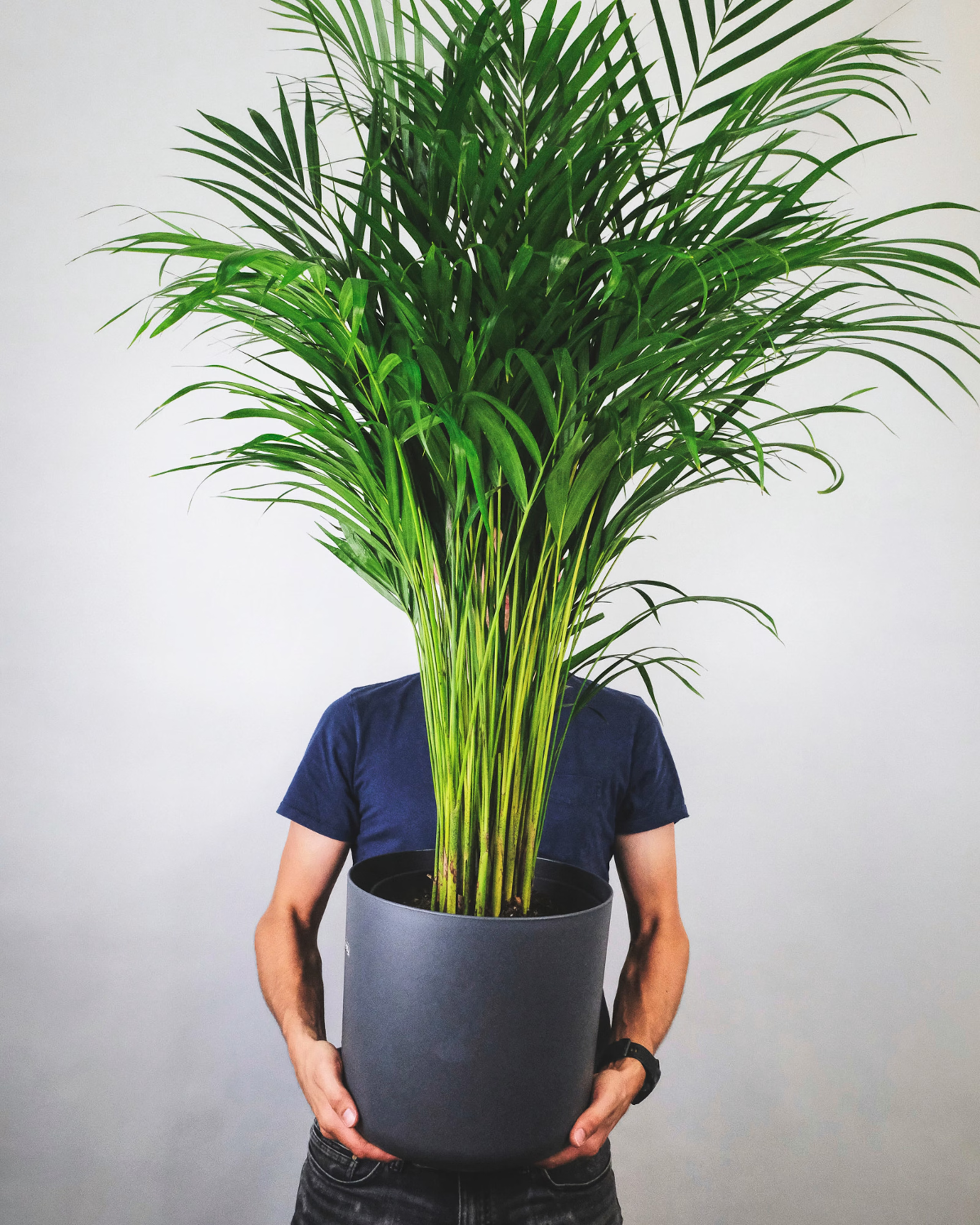
The areca palm — also known as the bamboo palm or golden cane palm — is the world's best-selling indoor palm, and for good reason. Its elegant, yellow-green stems and arching, feather-like fronds create an instantly tropical atmosphere that no artificial plant can match. And unlike many palm species, the areca palm actually copes quite well indoors.
Origin
Dypsis lutescens originates from Madagascar, where it grows along riverbanks and in moist, shaded forest. It naturally grows in clusters — hence the dense, multi-stemmed appearance in the pot. In the wild it can reach 10 metres, but indoors it stays at a manageable 1.5–2.5 metres.
Light
The areca palm needs bright, indirect light to thrive and grow. Place it near a south- or west-facing window without direct rays, or right at an east-facing window for morning light. In too little light it grows extremely slowly, lower fronds yellow, and the plant loses its fresh, golden-green colour. Moving it to a sheltered spot or shaded balcony in summer is beneficial.
Watering
Keep the soil evenly moist during the growing season, but never let the plant stand in stagnant water. Water when the top 3–4 cm of the surface has dried out. Like calathea, the areca palm reacts to fluoride in tap water with brown leaf tips — use filtered or collected rainwater if possible.
Humidity
The areca palm thrives at 50–60 % humidity or more. Place it on a tray of water and pebbles, or use a humidifier. Misting the leaves is welcome but not sufficient alone.
Fertilising
Fertilise every four weeks with a liquid fertiliser for palms (or a balanced NPK formula) from April through September. The palm needs extra magnesium and iron — deficiency shows as yellow-green streaks along the fronds. Palm-specific fertilisers usually contain these nutrients. Do not fertilise during winter.
Cleaning & Pruning
Dust accumulates on the long fronds and reduces photosynthesis. Wipe the fronds with a damp cloth once a month. Cut away yellowed or brown fronds with a sharp, sterile pair of scissors — cut close to the stem but avoid damaging healthy tissue.
Note: Never cut off the central growing tip — it will kill that stem.
Air Purification
The areca palm is one of the most effective air-purifying houseplants. NASA's study showed it filters formaldehyde, xylene, toluene, and acetone. It also releases moisture — a natural humidifier in dry rooms.
Common Problems
- Brown leaf tips — most common issue. Causes: dry air, fluoride in water, underwatering, or cold drafts. Trim brown tips along the leaf's natural angle.
- Yellow fronds — too little light, overwatering, or nutrient deficiency.
- Scale insects — treat with insecticidal soap or remove manually with an alcohol-dipped cotton swab.
- Spider mites — common in dry air. Increase humidity and wash fronds with water.