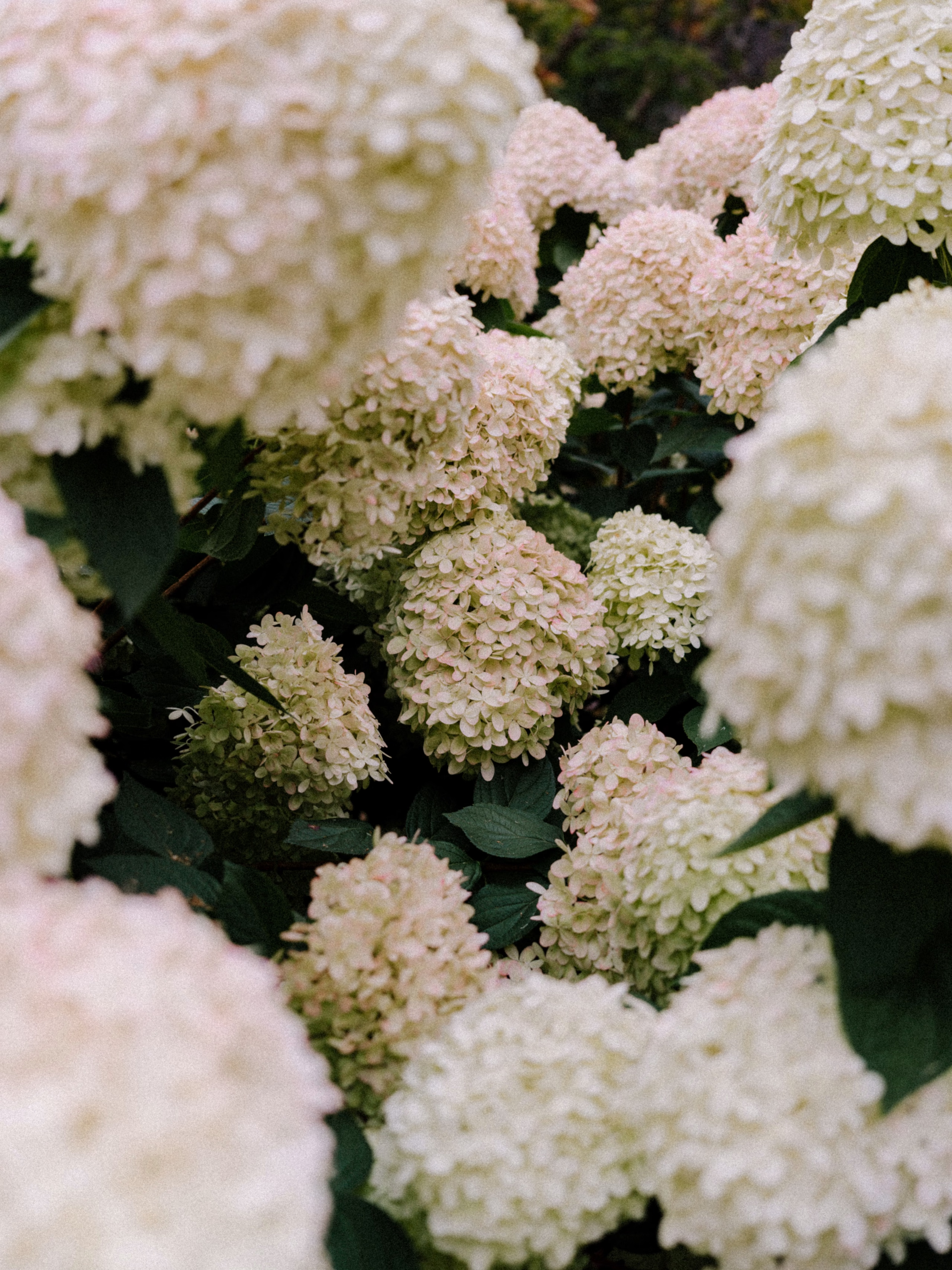
The panicle hydrangea (Hydrangea paniculata) is for many the best hydrangea for Nordic gardens. Its hardiness is superior — well-cared-for specimens handle zones 4–5 without problems — and its blooming season is impressively long, from July right into October. What makes it especially decorative is that the white to cream-yellow panicles gradually turn pink during autumn, creating a two-toned drama against yellowing leaves.
Popular Cultivars
'Limelight' — probably the best-selling panicle hydrangea in Scandinavia. Blooms in lime-yellow-white and turns beautifully pink. Upright habit up to 200 cm.
'Vanille Fraise' — starts white and transitions to deep strawberry-pink. More compact and graceful in form.
'Little Lime' — a lower-growing variant of 'Limelight', suitable for smaller gardens and containers.
'Pinky Winky' — two-toned panicles with white flowers at the top and pink at the base. Dramatic effect.
'Phantom' — one of the largest cultivars with enormous 30 cm panicles. Needs staking.
Light
Panicle hydrangea thrives best in sun to partial shade. Unlike bigleaf hydrangea it tolerates more sun. In moist positions with full sun it flowers most abundantly.
Watering
Keep the soil evenly moist during the establishment period (first 1–2 years). Established shrubs are relatively drought-tolerant but flower better with regular watering during dry periods.
Feeding
Fertilise in spring with a general fertiliser or one designed for flowering shrubs. An extra application in June prolongs flowering. Avoid fertilising after July, as the plant then needs to prepare for winter.
Pruning
H. paniculata blooms on the current season's new growth, making it easy to prune. Cut all branches down to 50–70 cm in spring (April) — the harder you cut, the fewer but larger flower clusters. Never prune in autumn; the old flower stalks provide winter interest and protect the buds from frost.
Overwintering
Panicle hydrangea is hardy and needs no special protection in most parts of Scandinavia. In zone 5, a little brushwood or leaves around the base during the first winter is wise.
Planting
Plant in a partially shaded to sunny position in well-draining but moisture-retentive soil. Add plenty of compost at planting time. Allow 150–200 cm between shrubs when planting as a hedge.
Common Problems
Drooping flower clusters despite staking often results from varieties with heavy panicles (like 'Phantom') — position the shrub in a wind-sheltered spot and stake early during flowering.
Brown-patched leaves can be caused by too much sun, water shortage, or fungal infection. Ensure even watering and good air circulation.
Fun Fact
Hydrangea paniculata is one of the few hydrangea species that can grow as a full-sized tree (up to 6 m) if allowed to. In Japan it is sometimes used as a street tree. The name "paniculata" comes from the Latin panicula, referring to the cone-shaped structure of the flower (a panicle).