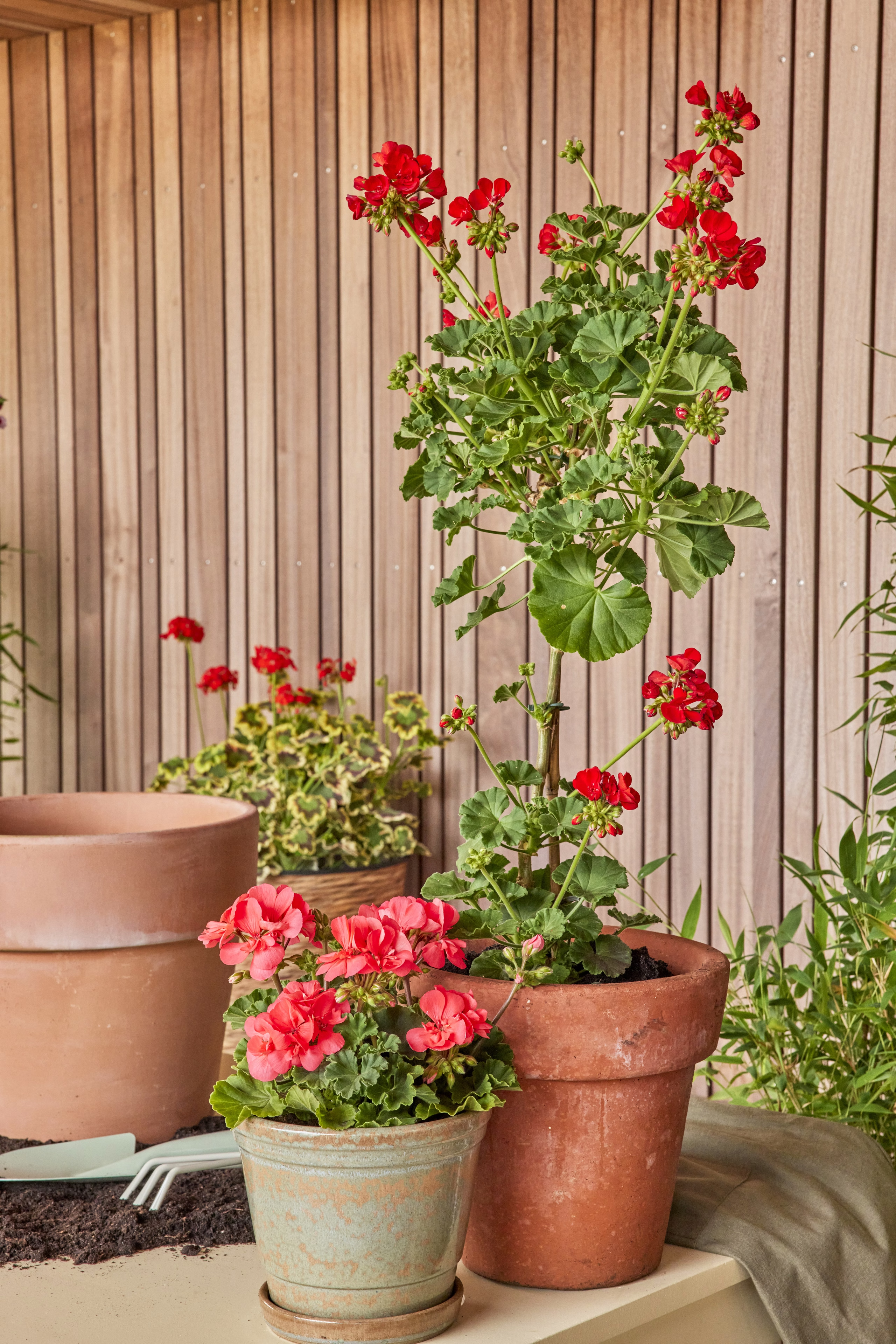
The geranium (Pelargonium) is an institution in the Scandinavian summer landscape. From city balconies to rural farmhouses — the red, pink, or white flower display in the window box is one of the most beloved features of summer. But geraniums are more than a seasonal pleasure: with proper care they can live for many years and overwinter indoors to bloom again the following summer.
Origin
Geraniums (Pelargonium) originate from South Africa and were brought to Europe by Dutch traders in the 17th century. They were quickly appreciated by European botanists and nobility, and during the 19th century became a favourite in Victorian gardens. It is worth noting that pelargoniums are botanically distinct from true geraniums (Geranium), even though they are often confused in everyday speech.
Light
The geranium loves sun — the more, the better. Full sunlight in a south-facing window or on a sunny balcony is ideal. In too little sun, the plant stretches, blooms poorly, and tends to become leggy. At least 4–6 hours of direct sun per day is recommended for good flowering.
Watering
Water regularly but never let the plant stand in stagnant water. Geraniums are sensitive to overwatering — leaves yellow and roots can rot. Water when the top 2–3 cm of soil has dried out. In summer outdoors, watering every other day may be needed in hot weather. Indoors in winter, water very sparingly — about once every ten days.
Feeding
During the flowering season (May–September), fertilise every two weeks with a potassium-rich fertiliser (K) — specific flowering fertilisers work well. Potassium stimulates flower formation. Avoid nitrogen-rich fertilisers, which produce a lot of leaves but fewer flowers.
Deadheading — The Key to Denser Flowering
Regular removal of spent flower heads (deadheading) is essential for continuous blooming. Pinch off the entire flower stalk down to the next leaf joint. Also do a harder pruning in autumn before overwintering and in spring to stimulate new, compact growth.
Overwintering
Geraniums are annual outdoors in Scandinavia but can easily be overwintered indoors: cut the plant back to about 10–15 cm in autumn, place in a cool (5–10 °C), bright room — a cold veranda, basement window, or garage with a grow light — and water very sparingly during winter. Move out and start fertilising again in May when frost nights are past. An overwintered geranium already gives a strong, ready-to-bloom plant in May — completely free compared to buying new each year.
Popular Types
- Zonal geraniums — the classic, upright geraniums with round flower heads
- Trailing geraniums (Pelargonium peltatum) — hanging varieties perfect for baskets and window boxes
- Regal geraniums (Pelargonium grandiflorum) — large, spectacular flowers; prefer growing indoors
- Scented geraniums — grown for their fragrant leaves (rose, lemon, mint); used in cooking
Common Problems
- Yellowing lower leaves — natural ageing, but can also indicate overwatering
- Streak virus (brown or fading patterns) — viral infection, often spread by insects; remove affected plants
- Grey mould (Botrytis) — occurs in high humidity and poor air circulation; remove affected parts and improve ventilation