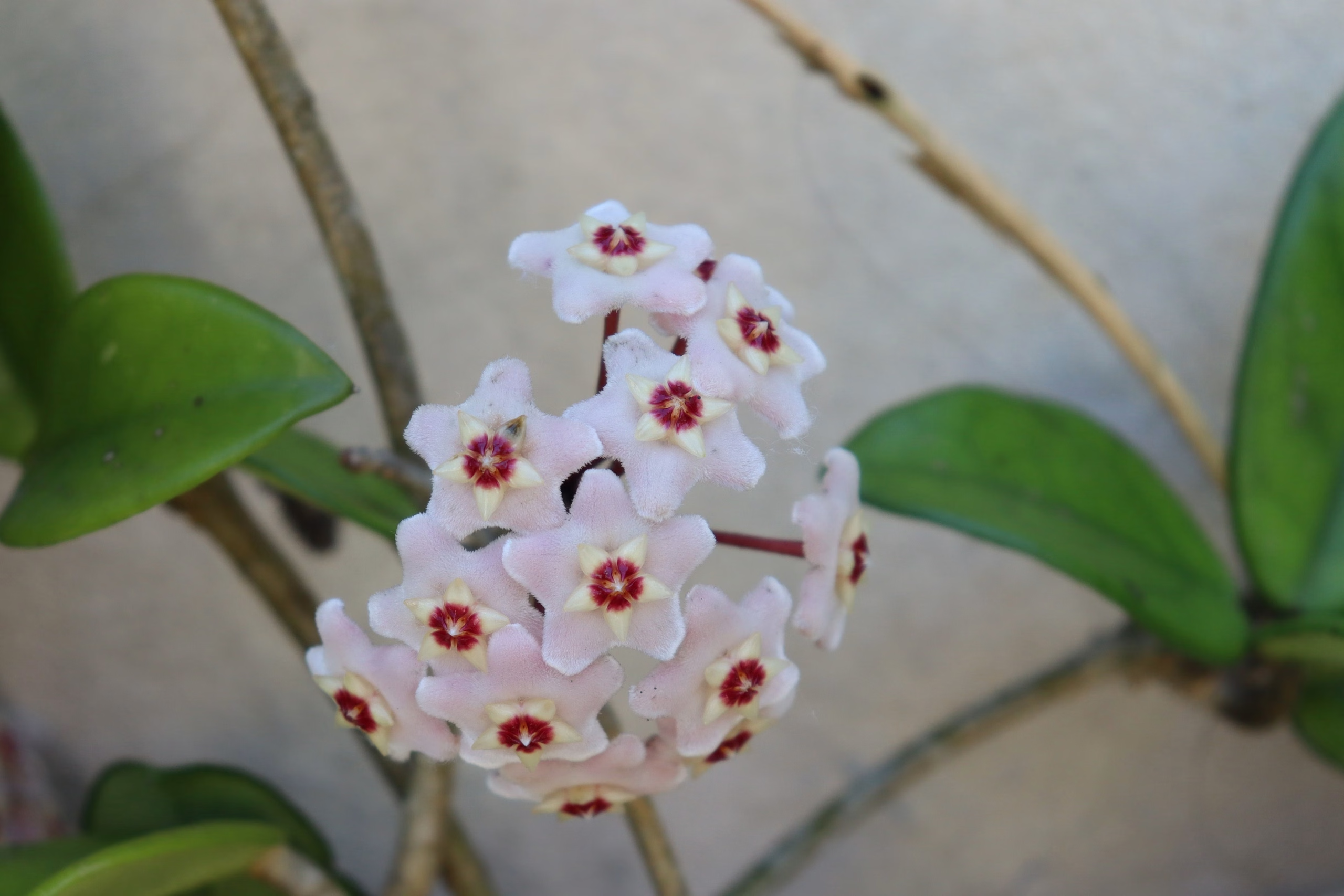
Hoya carnosa — the wax plant — is one of the most beloved and collected houseplants. The appeal is easy to understand: the waxy, thick leaves are beautiful year-round, and when the flower clusters — called umbels — open up, the sight is breathtaking. The star-shaped flowers, white with a pink corona, gleam as if made of porcelain. And the fragrance, especially in the evening, can fill an entire room with a sweet, honey-like aroma.
Origin
Hoya originates from Southeast Asia and eastern Australia, where it climbs and clings along trees and rock faces in tropical and subtropical forests. Its natural habitat is moist but with good drainage — the roots never sit in standing water.
Flowering
Hoya's flower clusters are miniature masterpieces — tightly packed star-shaped flowers with a porcelain sheen. At the centre of each flower sits a raised corona in deep pink that contrasts with the white petals.
Important rule: Never cut off the old flower stalks (peduncles) after flowering — hoyas bloom again on exactly the same spots year after year!
Hoya needs a little stress to flower: let it become pot-bound, give it a brighter position in summer, and allow slightly cooler, drier conditions in winter.
Light
Hoya needs good light to flower. An east-, west-, or south-facing window is ideal. Direct sun can burn the leaves, but a couple of hours of morning sun is welcome. Without sufficient light it grows, but rarely flowers.
Watering
Hoya is drought-tolerant thanks to its succulent-like leaves that store water. Let the soil dry out thoroughly — literally the entire soil volume — before watering again. During autumn and winter, you can go down to every two to three weeks. Overwatering is the most common problem with hoya. Slightly too dry is better than too wet.
Fertilising
Fertilise every 3–4 weeks during the growing period with a fertiliser high in potassium and phosphorus — this stimulates flowering. Avoid nitrogen-rich fertilisers that favour leaf growth at the expense of flowers.
Propagation
Hoya is easily propagated from cuttings: cut a piece with 2–3 leaves and a node, remove the leaf closest to the cut end, and place in perlite or water — roots appear within 2–4 weeks. Hoyas can live and bloom for decades with proper care — a truly worthwhile long-term investment.
Popular Varieties
- 'Compacta' — curled, folded leaves, unique texture
- 'Variegata' — green and cream-white leaves with a pink tinge
- Hoya kerrii — heart-shaped leaves, a perfect gift
- Hoya pubicalyx — dark leaves with silver spots, dark wine-red flowers