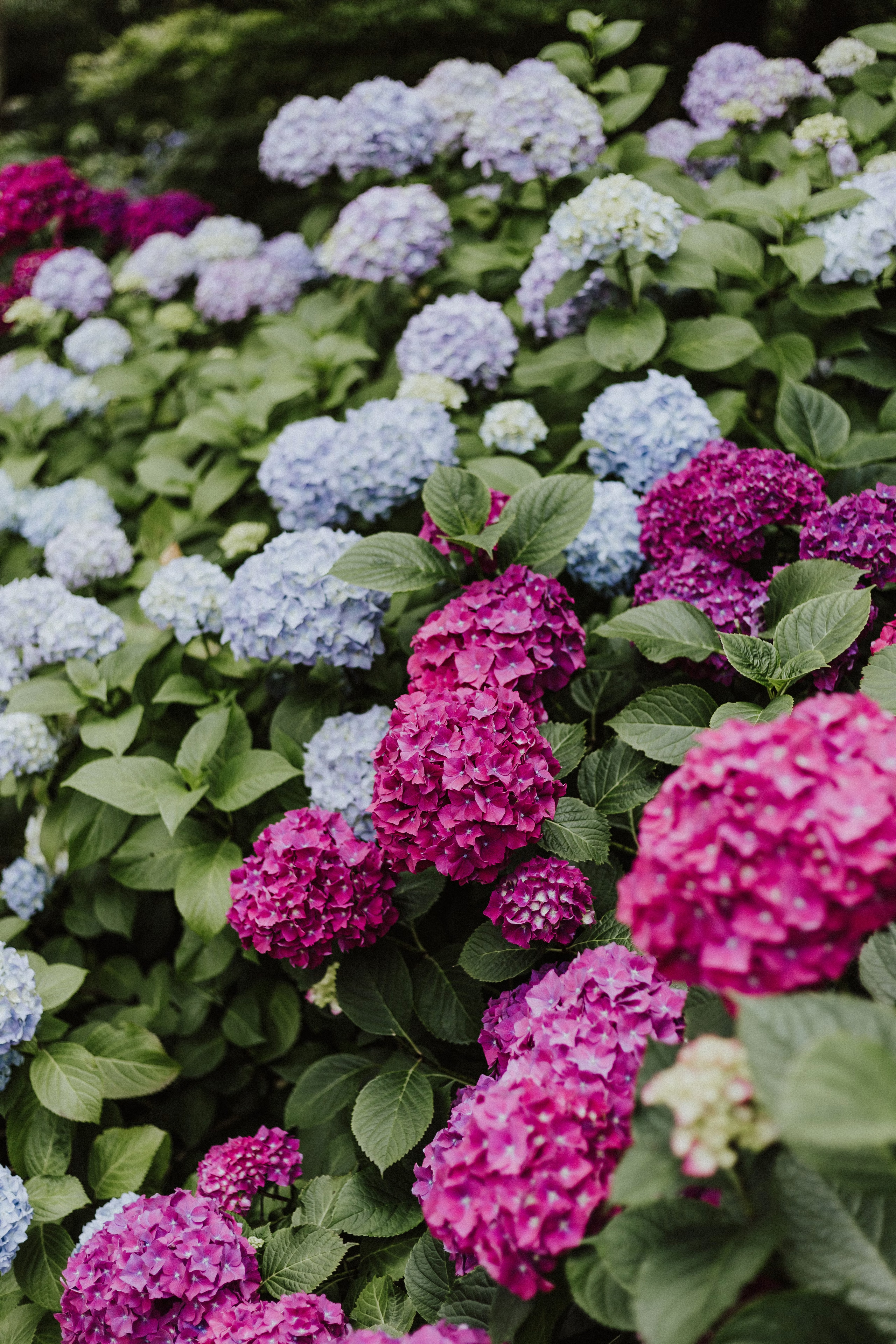
Hydrangea has undergone a remarkable popularity journey in Scandinavia. Once regarded as a stuffy funeral shrub, it is today one of the most purchased garden shrubs in the region — and rightly so. Its enormous flower clusters in pastel shades, long blooming season, and ability to cope with partial shade make it unique among garden plants.
Varieties for Scandinavian Gardens
Smooth hydrangea (Hydrangea arborescens) — with the classic 'Annabelle' — is the hardiest and tolerates zone 4. Blooms on the current season's growth in large white globes.
Panicle hydrangea (Hydrangea paniculata) is also very hardy (zone 4–5). Cultivars like 'Limelight' and 'Vanille Fraise' bloom July–October with conical white-to-pink panicles.
Bigleaf hydrangea (Hydrangea macrophylla) — the classic blue and pink mopheads — is the most beautiful but least hardy (zone 1–2). Requires winter protection in colder parts of Scandinavia.
Blue or Pink — Soil pH Decides
A fascinating property of H. macrophylla is that flower colour is influenced by soil pH and aluminium availability. Acid soil (pH below 6) with available aluminium gives blue flowers; lime-rich, neutral soil (pH 6–7) gives pink. White varieties are unaffected by pH.
Care
Light
Hydrangea thrives best in partial shade — morning sun with protection from hot midday sun is ideal. Full sun produces brown-patched leaves and dries the plant out quickly. One of the few garden shrubs that blooms well in shadier positions.
Watering
Hydrangea's large foliage transpires a great deal of water. Water generously and regularly, ideally daily during hot periods. Never let the plant dry out completely — it signals with drooping leaves but can be damaged. Mulch around the base to retain moisture.
Feeding
Fertilise with a flowering fertiliser (rich in potassium and phosphorus) in May and again in June. Avoid nitrogen fertiliser late in the season.
Pruning
The correct pruning time depends on the species: H. macrophylla blooms on the previous year's growth — only remove dead and weak branches immediately after flowering. H. paniculata and H. arborescens bloom on the current season's growth and can be pruned hard in spring.
Overwintering
Protect bigleaf hydrangea with a brush-wood screen or mound up with leaves in November. Remove protection in April.
Common Problems
Drooping leaves despite watering can result from root damage or disease. Check that the roots are not damaged by ants or water shoot growth.
Failure to flower is most common with H. macrophylla and usually results from over-pruning that removed the flower buds, or frost damage to the previous year's shoots.