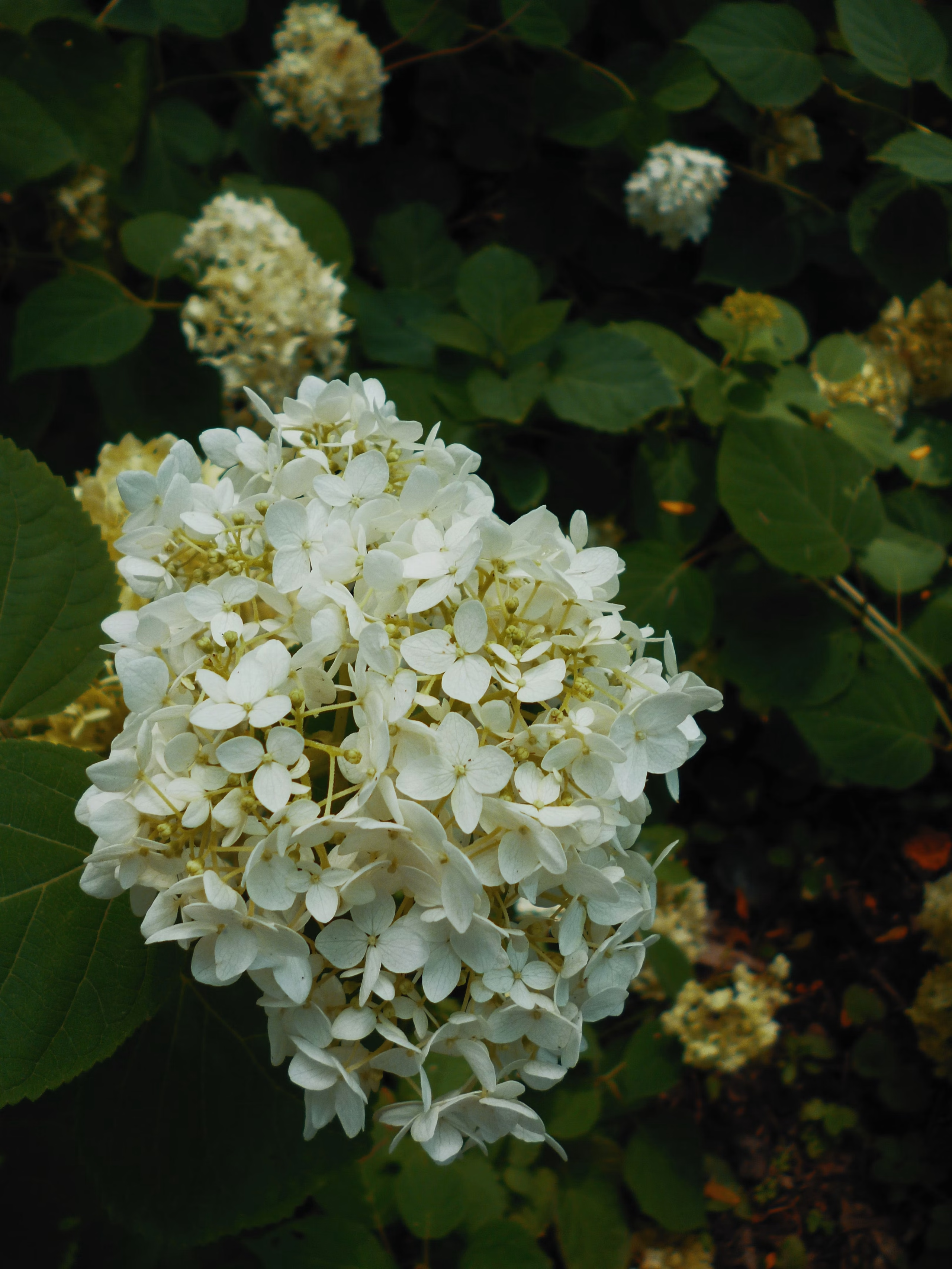
The smooth hydrangea (Hydrangea arborescens) is North American in origin and the only hydrangea species native to the United States. Its hardy nature has made it a safe choice in Scandinavian gardens — it tolerates cold down to –30 °C in the right position. The cultivar 'Annabelle' is one of the most widely known garden plants, with its iconic white snowballs that can reach 30 cm in diameter.
Popular Cultivars
'Annabelle' — the classic, well-known cultivar with enormous white flower balls. Blooms July–September. One of the best-selling garden shrubs in Scandinavia.
'Incrediball' — an enhanced 'Annabelle' with stronger stems that don't bend under the weight of the flower heads. Handles rain and wind better.
'Invincibelle Spirit' — a newer cultivar with rose-pink flower clusters, developed as a hardy alternative to bigleaf hydrangea. Blooms long, from July to frost.
'Hayes Starburst' — a double-flowered cultivar with star-shaped petals. Rarer but very beautiful.
Care
Light
Smooth hydrangea is adaptable — it blooms in everything from full sun to deep shade, but thrives best in partial shade. In full sun it needs generous watering and may need protection from hot midday sun.
Watering
Despite its hardiness, H. arborescens is moisture-hungry. Water generously and regularly, especially during dry summers. Mulch generously around the base to retain moisture and keep the roots cool.
Feeding
Fertilise with a balanced flowering fertiliser in May and again in June. Choose a fertiliser with a lower nitrogen ratio to avoid excessive leaf growth at the expense of flowering.
Pruning
H. arborescens blooms on the current season's growth and can be pruned hard every spring. Cut all stems down to 20–30 cm above ground in April for a new, compact habit and large flower heads. If you skip hard pruning, a bushier crown forms with more but smaller flower clusters — both methods work.
Overwintering
No overwintering needed in zones 1–4. In zone 5, a layer of leaves or compost around the base is recommended. The dried brown flower heads can usefully be left on through winter — they provide winter interest and protect the buds.
Planting
Plant in humus-rich, well-draining soil. Add plenty of compost at planting time. H. arborescens establishes quickly and tolerates transplanting better than most shrubs. It works well as a deciduous hedge, in borders, in groups, or as a specimen plant.
Common Problems
Drooping flower stems are the most common complaint about 'Annabelle' — the heavy flower clusters bend the stems in rain. Solve this with the cultivar 'Incrediball', which has stronger stems, or stake with canes and string.
Sparse flowering usually results from too much shade or insufficient watering. Move to a brighter position with more sun.